
Having shown some initial signs of recovery in November, India's apparel exports declined by over 11 per cent to $862 million in December 2009 on account of poor demand from the United States and the Euro zone.

Rupee depreciation pushes apparel exporters' margins by 5-7%.

Apparel exports to Japan are expected to grow by 20-25 per cent year on year from the current $220 million on account of rising opportunities for domestic exports, AEPC said on Saturday. Apparel Export Promotion Council (AEPC) said that rising opportunities due to changing geopolitical landscape, government supports like production linked incentive, mega park scheme, improving the quality standard, getting sustainable and utilising benefits of free trade agreements with major markets are the key growth drivers. To promote exports to Japan, the council is organising a two-day show in Gurugram.

Backed by the China-plus-one policy, India's textile and apparel exports have seen a 53 per cent growth during the April-November period of the current fiscal year at around $26 billion. This compares to the figure of $17 billion during the same period in FY21. According to Wazir Textile Index, all major companies including Welspun, Vardhman, Trident, KPR Mills, Indo Count, RSWM, Filatex, Nahar Spg and Indorama have posted higher sales during the first half of the current fiscal year compared to the pre-pandemic year.

Even as the industrial cycle has ground to a halt during the 21-day lockdown, the industry has been hit hard by foreign orders from major clients in the US and Europe being cancelled. Also, a sudden lack of labour has crippled the sector because of a mass exodus of workers from industrial units to the hinterland.
Indian exporters are unlikely to receive direct tariff refunds from the US's $166 billion payout, but the rollback of reciprocal duties is enhancing their pricing power and improving order prospects, particularly in textiles, apparel, and engineering goods.

The proposed trade deal with the 27-nation European Union (EU) is expected to provide zero-duty access to the $95 billion European market for Indian textile and apparel manufacturers. Currently, India's share of the European market is just 6 per cent, or $5.5 billion.

The USA's steep 50 per cent tariffs on Indian goods entering America will severely impact exports and job creation in labour-intensive export sectors such as shrimp, apparel, leather and gems and jewellery. Exporters said that the imposition of a 25 per cent penalty on India over and above the 25 per cent tariffs move will disrupt the flow of Indian goods to its largest export market.


The fear of being boycotted by large US stores like WalMart, JC Penny and GAP has led Indian apparel exporters to formulate a code to eliminate child labour from Rs 46,000 crore (Rs 460 billion) garment export business.

"By January 2010 there could be massive job losses on unprecedented scale which could lead to social problems in apparel manufacturing clusters across the country," AEPC Chairman Rakesh Vaid said.

Textiles, pharmaceuticals, chemicals, engineering goods, gems and jewellery exports will receive a boost from the free trade agreement between India and the 27-nation European Union, according to exporters.
India's exports rose 9.03 per cent to $38.49 billion in April, the highest in six months, driven by healthy growth in sectors such as electronics and engineering goods, while the trade deficit widened to a five-month high of $26.42 billion. According to the commerce ministry data released on Thursday, imports increased by 19.12 per cent year-on-year to $64.91 billion in April due to a rise in shipments of crude oil and fertiliser.

E-commerce giant Amazon plans to make a mega-investment of $35 billion, over Rs 3.14 lakh crore, in India by 2030 across its businesses with a focus on AI-driven digitization, export growth and job creation, a senior company official said on Wednesday.
Enthused by substantial growth in cotton apparel exports since dismantling of quota system in January 2005, India expects their exports to the United States to become nearly three times from the present $2.30 billion to $6 billion this fiscal.
Close on the heels of US retailer J C Penney's announcement to enhance outsourcing from India, domestic apparel exporters have firmed up plans to hold a mega garment show in Dallas and New York.
With the foreign apparel market looking towards India to meet its requirements in the post-quota period, the Apparel Export Promotion Council will be organising mega shows in the United States in June.
The 4th India Sporting Goods Fair (ISGF) showcases athletic gear and equipment from 75 exhibitors, highlighting the government's commitment to promoting sports goods manufacturing in India.
The country's exports rose marginally by 0.61 per cent to $36.56 billion in January, while trade deficit widened to a three-month high of $34.68 billion, government data showed on Monday.

On August 7, the US president announced doubling tariffs on Indian goods to 50 percent for India's purchases of Russian crude oil, but gave a 21-day window to negotiate an agreement.
The 4th India Sporting Goods Fair (ISGF) is set to take place, showcasing athletic gear and equipment from across the country, as the government pushes to establish India as a global hub for sports goods manufacturing.
Continuing their upbeat performance, readymade garments exports registered a rise of 33.04 per cent in value terms at Rs 2,320.95 crore (Rs 23.2 billion) in February this year as against Rs 1,781.71 crore (Rs 17.81 billion) in Febraury last year.
Recession-hit retailers in the US and Europe are increasing their purchases from Bangladesh as it is able to supply garments at a relatively less price due to low labour cost and better economies of scale, experts said. Data collected by the Apparel Export Promotion Council, the body for the promotion and facilitation of garment-manufacturing and their exports, show Bangladesh overtook India after August 2008.

After registering a positive growth for two months, India's exports slipped into negative territory again, contracting 2.17 per cent year-on-year to $38.73 billion in May due to a fall in global petroleum prices, while trade deficit narrowed at $21.88 billion during the month.

India will be able to bag extra orders worth $three billion for garment exports from the European Union, if the country enters into a Free Trade Agreement with the EU, apparel exports body said on Monday.

According to an industry expert, companies such as Trident, Welspun India, Arvind, KPR Mill, Vardhman Textiles, Page Industries, Raymond, and Alok Industries stand to gain, as revenue from the US market accounts for 20-60 per cent of their earnings.
Interestingly, none of the top large apparel exporting countries, including the US, saw any significant jump in shipment to the UAE
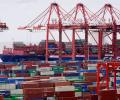
The country's exports for the first time crossed the $400 billion mark in a fiscal on healthy performance by sectors such as petroleum products, engineering, gems and jewellery, and chemicals, according to the commerce ministry's data released on Wednesday. The merchandise exports rose by by 37 per cent to $400.8 billion in 2021-22 until March 21 against $292 billion in 2020-21. Previously, the outbound shipments had touched a record of $330.07 billion in 2018-19.

India's merchandise exports in October rose by 17.25 per cent to $39.2 billion against $33.43 billion a year ago, according to government data released on Thursday. Imports increased by 3.9 per cent to $66.34 billion in October compared to $63.86 billion in the year-ago period.

Communication channels between India and the US are open to resolve the ongoing tariff issues, and the glitch in trade ties is only temporary, given the long-term relationship between the two nations, government sources said on Wednesday. The US' 50 per cent tariffs on Indian exports to America came into effect from August 27, barring a few sectors.
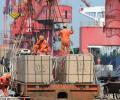
India's exports fell for the fourth straight month in June as shipments of key segments like petroleum and textiles declined but the country's trade turned surplus for the first time in 18 years as imports dropped by a steeper 47.59 per cent.

Snapping the two months slide, the country's merchandise exports rose marginally by 0.5 per cent to $34.58 billion in September while trade deficit narrowed to $20.78 billion. According to official data released on Wednesday, imports increased by 1.6 per cent to $55.36 billion in September compared to $54.49 billion in the year-ago period. The trade deficit, or the gap between imports and exports, was $20.8 billion during the same month last year.

The industry has requested the Reserve Bank of India for restructuring of loans, the chairman said. According to estimates, the sector has a loan burden of about Rs 1 lakh crore (Rs 1 trillion).
Imports also fell for the eighth consecutive months, down 0.75 per cent to $41.14 billion in January, widening the trade deficit to a seven-month high of $15.17 billion.

China accounts for more than one-third of the apparel export market
